
In spraying activities, the role of nozzles is very important so checking the volume of product distributed is crucial. In fact, sprayers and herbicide bars are responsible for distributing the plant protection solution over the target.
The nozzles transform the energy that the fluid possesses into kinetic energy by transporting the water/pharmaceutical solution to the target. Effective distribution enables the farmer to achieve the desired result and save money. In fact, a solution that does not reach its destination leads to greater expenses to complete the spraying cycle, greater drift as well as possible penalties if the product pollutes the surrounding environment.
These factors lead the farmer to wonder how much solution is actually being spread on the leaves. To verify this, there is a formula for understanding the effectiveness of the jet.
How to carry out verification of the volume of plant protection product distributed by nozzles
In the first instance, it is necessary to check that all adjustments, of the open nozzles, are well made. Second, it is necessary to determine the actual flow rate of the sprayers through the sum of the flow rates of the open nozzles.
To calculate this first factor, we need to determine:
- Qe = effective sprayer flow rate (l/minutes)
- Ve = Volume actually distributed (l/ha)
- V = Forward speed (km/h)
- I = inter-row width
- N = number of rows
- 600 = fixed number

With this calculation, Ve could be lower or higher than distributed. To obtain a distribution volume equal to the intended volume, the pressure must be acted upon until Qe is equal to Qv (desired flow rate).
The equation to be calculated involves the following factors:
- Qe = effective sprayer flow rate (l/minutes)
- Qv = desired flow rate (l/minutes)
- Pe = actual operating pressure (bar)
- Pv = desired operating pressure (bar)
To determine it, the following equation must be carried out:

If the pressure exceeds 15 bar, it is necessary to replace the nozzles. Such replacement is also necessary for pneumatic sprayers, but in this case only if the 2-bar threshold is exceeded.
Example
To facilitate guidance for practitioners, we provide a practical example that allows an easier understanding of the above.
Imagine you want to distribute, in a one-hectare plot of land, 500 liters of water/phytopharmaceutical solution, proceed at a forward speed of about 4 km/h, and operate in soils of which the rows are 4 meters wide.
Considering the given data, we can carry out the following calculation:

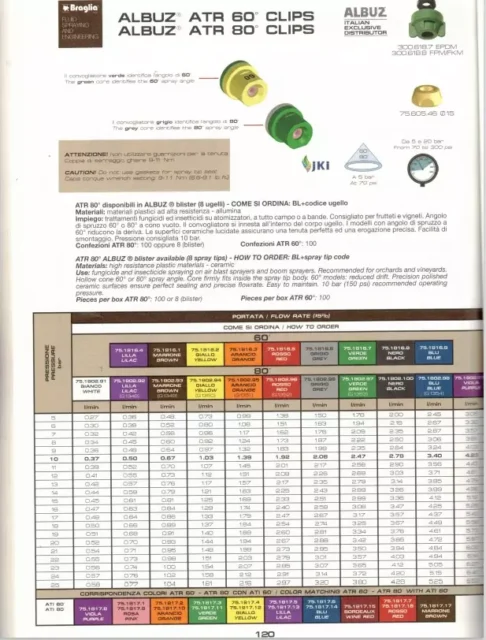
With this calculation, we determined the flow rate in l/minute of all sprayer nozzles. Through a readily available nozzle chart, we will be able to identify the nozzle best suited to our needs.
Imagining that the open nozzles of the sprayer are 14, we will get the following result: 13.33/14=0.95.
This factor identifies the liter per minute delivered by the individual nozzle at a given pressure.