
In Italy, olive cultivation is one of the cornerstones of our country’s agricultural and food production. According to Atlas data, 2020 sees Italy as the world’s second largest olive oil producer, second only to Spain.
Appropriate necessary as these data refer to the quantity put on the market and not the quality of the finished product. These elements lead to the conclusion that in the Belpaese olive cultivation is primary and strongly rooted in the territory.
However, whether producing oil or olives for consumption, cultivating the olive grove also requires great care in order to bring the best possible product to the table. In fact, the quality of the finished product goes through so many factors that, if neglected, lead to suboptimal product yields bringing the farmer a loss of income both in terms of production and sales.
Among the most important practices for a good olive tree yield are:
- Land management
- Fruit defense
- Pruning
- Irrigation
Key steps in olive cultivation
The first step in successful cultivation of Olive trees is soil management. Olive trees, in fact, can adapt well to different soils, however, to have quality olives it is necessary to
- Creating the right harmonious root system
- The establishment of adequate gas exchange
- good water retention
- endowment of organic matter
- balanced microbiological activity
Therefore the ideal soil is loose soil, avoiding compaction as much as possible while minimizing tillage. In addition, it is preferable to perform tillage when the soil is dry and temperate.
Planting new trees, on the other hand, is best done in the spring on plowed soil to promote water drainage. These preliminary operations are generally performed in the fall months in order to prepare the soil in the right timing.
After preparing the olive grove, the fruit trees should be protected from weeds and pests. In fact, weeds compete with orchards for water and nutrients, creating suboptimal fruit. In addition, insects, especially flies, can lurk in the plants and attack the fruit to feed.
To remove plants from olive groves, one can resort to:
- Manual mowing of grass or with a mulcher
- pyrodisaster
- mulching
- chemical weeding (not allowed in organic farming)
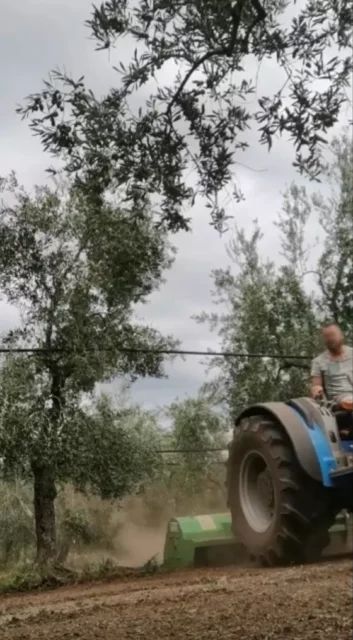
Next comes fertilization, composts or manure that can be supplemented with other substances. Spraying and pruning. Even in this last practice, the flail mulcher can be used to help the farmer dispose of branch residues.
In addition, chopping produces humus that helps fertilize the soil.
The benefits of good chopping in the olive tree
Chopping pruning residues is a recommended agronomic practice in order to return some of the organic matter it needs to the soil.
It should be clarified, however, that for this type of practice to be beneficial to the soil, it is necessary for the mulcher to be able to ensure good shredding and defibration of the woody material, so as to facilitate rapid degradation by soil microflora.
Where this is not the case, in order to improve the degradation of the shredded material, a few quintals of manure or otherwise commercial products specifically designed to contribute microorganisms necessary for the degradation of the plant material should be distributed (at increased cost) before chopping.
There are cases in which wood fungi such as lead malaise, agents of cancers, have established themselves and are taking advantage of woody residues, increasing their inoculum potential; in these cases, chopping should be avoided.