
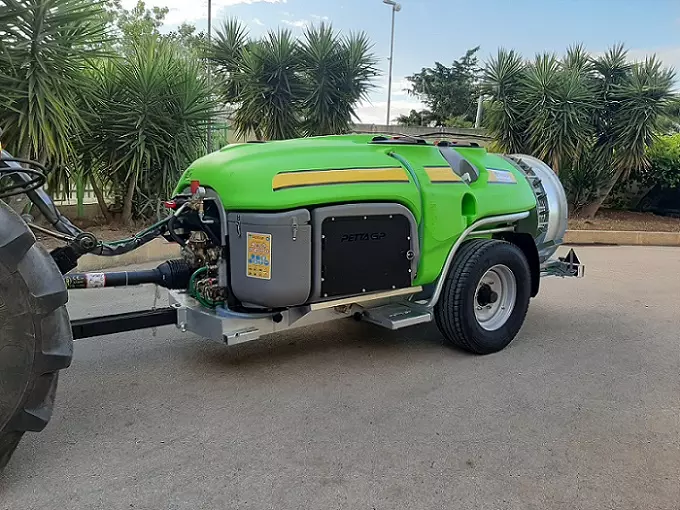
Sprayers are vital to agribusiness production, and just as it is important to choose the right machine for your soil, so too is maintenance, especially tank cleaning, vital to both results and costs for farmers.
In fact, cleaning the tanks, in addition to being a mandatory practice regulated by law, is necessary to avoid mixing of the agrochemicals that will be diluted. The choice followed by several operators in the sector, in order to facilitate this type of operation, has been to use the new polyethylene tanks, the advantages of which are related to the entirely smooth surfaces, which unlike fiberglass (which is increasingly in disuse and not entirely compliant with directives) avoids the sedimentation of the agrochemical on the walls themselves, with benefits for both the operator and people.
In fact, failure to maintain the reservoir can produce risks to the environment and to people who may consume agri-food products that are not optimally processed.
Tank cleaning as far as regulations are concerned is regulated by a European law, 2009/128/EC, and implemented in Italy by Legislative Decree. n. 150/2012.
Sanitization operations must be carried out by the operator, subject to compliance with applicable regulations, and always using personal protective equipment (PPE), at the end of each use of the machine.
Why it is important to clean the tank of spraying machines
In addition to the regulations governing tank cleaning of sprayers and weeding units related to the safety of the environment and people, tank cleaning is also related to practical use. In fact, part of the solution of water and pesticide ends up on the machine itself, and part remains in the tank.
Failure to maintain and clean the tank can lead to:
Administrative detention of the vehicle
Incompatibility between chemistry and physics of pesticides resulting in failure of agro-sanitary product yields
Cross-contamination
Pipe occlusion and consequent decrease in jet flow rate
A mixture of multiple plant protection solutions in addition to being ineffective, could lead to harmful effects on the implement, crops with consequences towards the end consumer.
The machine must always be rigorously cleaned inside and out to prevent mixture residue from occluding the spray outlet, thus wasting the solution, also leading to economic loss for the farmer.
Maintenance operations that can be performed by the operator
The farm operator can carry out the cleaning operations of the vehicle, whether it is a mist sprayer or a weeding unit, independently, in compliance with the laws. Tasks to be performed generally include:
Filter control
Filter cleaning
Replacing filters
Nozzle control
Nozzle direction control
Nozzle cleaning
Nozzle replacement
Checking nozzle flow rate (through appropriate agencies)
Plumbing integrity check
Checking the tightness and pressure of fittings
Lubrication of moving parts
Thorough washing of the exterior of the machine
Thorough washing of the inside of the tank
Resetting pressure in the regulator (at the end of the season)
When treatments involve the same product for several days, a cursory washing of the barrel is allowed, and when the treatment involves a new product, it is mandatory to remove any residual type.
Washing can be done with hand lances or with car wash systems (where present).
To avoid environmental damage, it is advisable to clean the machine on an impermeable material pad with suitable water drainage or at authorized centers. Field washing is allowed only away from sensitive or water collection points, preferably in a plot of land away from the crop.
it is appropriate to remind all operators that it is mandatory, in order to protect the safety of motorists, to clean the agricultural vehicle before entering roads intended for motor traffic.